How Generative AI Actually Works (No Fluff)
A plain-English breakdown of neural networks, transformers, LLM training, and diffusion models — explained for humans who hate complicated explanations.

How Generative AI Actually Works (No Fluff)
Written for humans who hate complicated explanations. If you've ever said "just explain it simply" — this one's for you.
So What Even Is Generative AI?
Old AI was a judge. You showed it a photo and it said "cat" or "not cat." That's it.
Generative AI is an artist. It doesn't just label things — it creates things. Text, images, code, music, videos. Stuff that didn't exist before.
Think of it this way:
- Old AI = a bouncer (yes/no)
- Generative AI = a chef (makes something new from ingredients)
The Evolution — How We Got Here
1950s–1980s: The Rule Era
Humans literally wrote every rule by hand.
if word == "happy" → positive
if word == "sad" → negative
Worked okay. But life is complicated. You can't write rules for everything.
1990s–2000s: Statistics Enter the Chat
Instead of hand-written rules, AI started learning patterns from data. Better. But still limited.
2012: Deep Learning Explodes 🔥
Neural networks went deep. A model called AlexNet shocked the world by recognizing images way better than anything before. The deep learning era had begun.
2017: The Game Changer — Transformers
Google published a paper called "Attention is All You Need."
That one paper changed everything. Every modern AI — ChatGPT, Claude, Gemini — is built on this idea.
2020–Now: AI Goes Mainstream
GPT-3, ChatGPT, Midjourney, Stable Diffusion, Sora. Generative AI went from research labs to your browser.
Part 1: Neural Networks — The Brain Analogy 🧠
Your brain has billions of neurons. They send signals to each other. When you see a cat, neurons fire until your brain says "cat!"
Neural networks copy this — in code.
The basic building block:
Input → Multiply by Weight → Add Bias → Activate → Output
- Weight = how important is this input?
- Activate = should this neuron "fire"?
The layers:
[Input] → [Hidden Layers] → [Output]
(data in)  (magic happens)  (answer out)
How does it learn?
- Make a guess
- Check how wrong it was (called Loss)
- Go backwards, adjust weights (called Backpropagation)
- Repeat. Millions of times.
Analogy: Like a student who guesses exam answers, checks the key, and adjusts their thinking. Over and over until they stop being wrong.
Key insight: It doesn't store if-else rules. It stores numbers (weights) that get tuned through practice. Like muscle memory — not a rulebook.
Part 2: Transformers — The Attention Trick 👀
Old language AI (called RNNs) read sentences one word at a time — left to right. Like reading and forgetting each page after turning it.
The problem:
"The animal didn't cross the street because it was too tired"
What does "it" refer to? The animal. Not the street.
Humans get this instantly. Old AI struggled. By the time it reached "tired", it had forgotten "animal."
Transformers said: read everything at once.
Instead of word by word, transformers look at the whole sentence simultaneously — like spreading a book flat on a table and seeing all pages at once.
The Attention Mechanism:
For every word, the model asks 3 things:
Q = What am I looking for?   (Query)
K = What do I offer?         (Key)
V = What's my actual info?   (Value)
Then it calculates: how much should each word focus on every other word?
"tired" → pays attention to "animal" (high score ✅)
"tired" → pays attention to "street" (low score ❌)
Result: every word gets a context-aware meaning. 🎯
The difference:
| Old RNN | Transformer | |---------|------------| | Word by word | All at once | | Forgets early context | Remembers everything | | Slow | Fast (parallel) | | Bad at long text | Great at long text |
Transformer is a concept (blueprint), not software. You build it using tools like PyTorch or TensorFlow. Think of it like electricity — it existed before any specific invention used it.
Part 3: How LLMs Are Trained 🎓
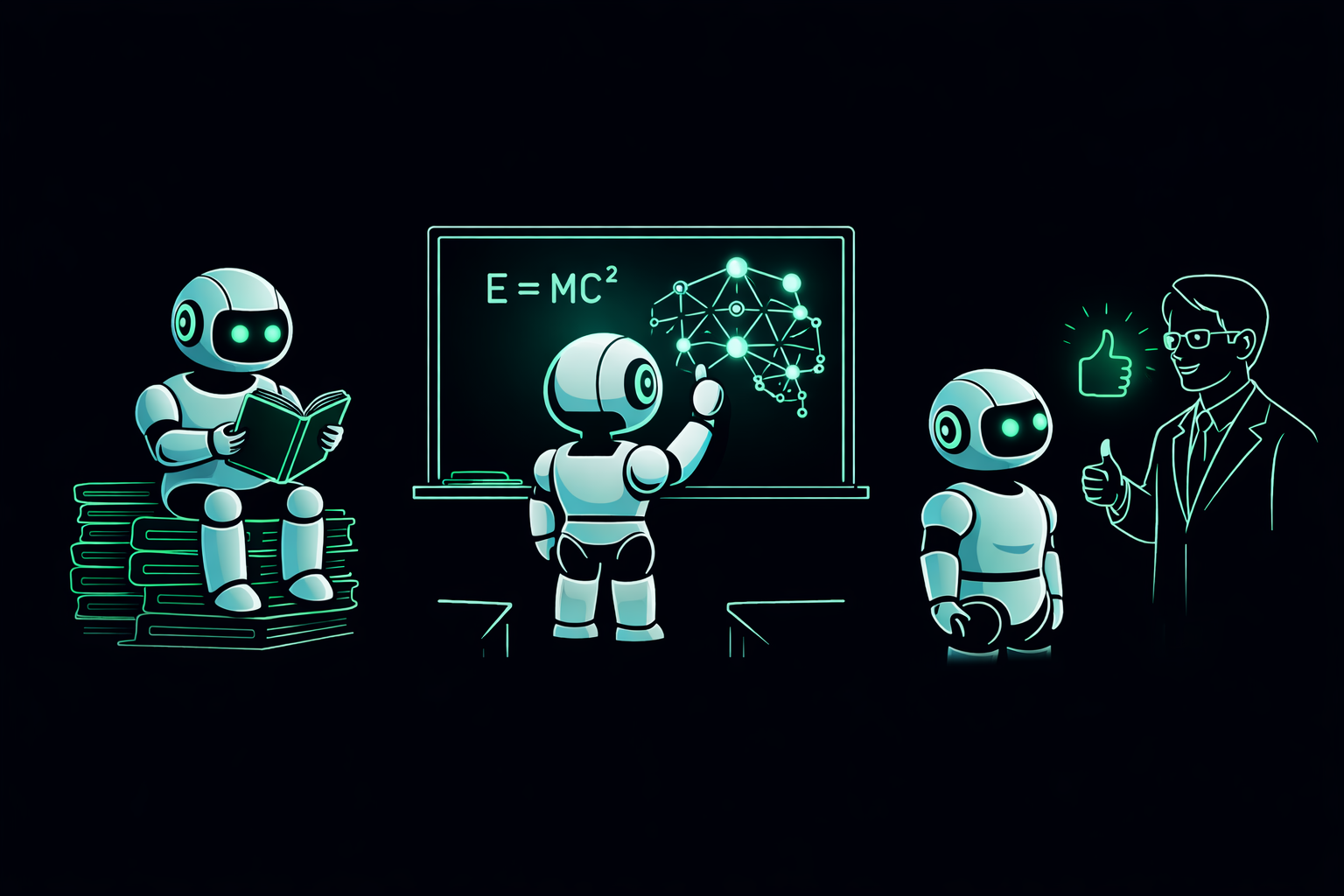
The training idea is almost embarrassingly simple:
Predict the next word.
That's it. Seriously.
"The cat sat on the ___"
Guess:
matfloorroofWrong guess → adjust weights → try again. Billions of times.
The 3 stages:
Stage 1 — Pre-training (learn everything)
Data:   Wikipedia + books + the entire internet
Task:   Predict the next word, forever
Result: Model learns grammar, facts, math, code, logic
Cost:   Millions of dollars 💸
Stage 2 — Fine-tuning (learn manners)
Data:   Human-written Q&A examples
Task:   Learn to respond like a helpful assistant
Result: Model stops being weird, becomes useful
Stage 3 — RLHF (polish it)
RLHF = Reinforcement Learning from Human Feedback

Humans rank responses → good ones get rewarded
Model learns: "do more of what humans like"
Result: Safer, smarter, less unhinged
Analogy:
Pre-training  = Reading every book ever written
Fine-tuning   = Going to school
RLHF          = Getting feedback from a really good teacher
Why does "predict next word" create intelligence?
Because to predict well, the model must understand:
- Grammar
- Facts
- Logic
- Context
- Common sense
It's forced to learn everything just to do one simple task. 🤯
Part 4: How Image AI Works — Diffusion Models 🎨
Text AI predicts words. Image AI works completely differently.
The core idea: add noise, then remove it.
Step 1: Take a real image
Step 2: Slowly add random noise until it's pure static
Step 3: Train the model to REVERSE this — remove noise
Step 4: Now give it random static → it sculpts an image!
Analogy: Imagine a sand sculpture.
- Adding noise = someone slowly smashing it into a pile of sand
- Training = AI learns to sculpt it back from sand
- At inference = give AI any pile of sand + a description → it makes something new 🗿
How does text connect to image?
When you type "a cat on the moon":
Text → converted to numbers (embeddings)
     ↓
These numbers guide the noise removal process
     ↓
Instead of a random image → you get YOUR image
This connection between text and images is handled by something called CLIP.
Real tools built on diffusion:
| Tool | Type | |------|------| | Midjourney | Diffusion model | | Stable Diffusion | Open source diffusion | | DALL-E 3 | OpenAI's diffusion | | Sora | Diffusion over video frames |
Video = same idea, just extended:
Image = 1 frame
Video = 1000 frames

Video AI = generate each frame + keep them consistent
The Full Picture — How It All Connects
Research Paper (Transformer concept)
         ↓
PyTorch / TensorFlow (someone codes it up)
         ↓
Train on massive data (pre-training)
         ↓
Fine-tune + RLHF (make it useful)
         ↓
Wrap in API (FastAPI / Hugging Face)
         ↓
Users interact via ChatGPT / Claude / Cursor 🌐
Written after a long Research where every analogy had to pass the "does a 10-year-old get this?" test. Turns out that's the best way to actually understand AI.
Anoop Singh
Tech Lead & AI Architect